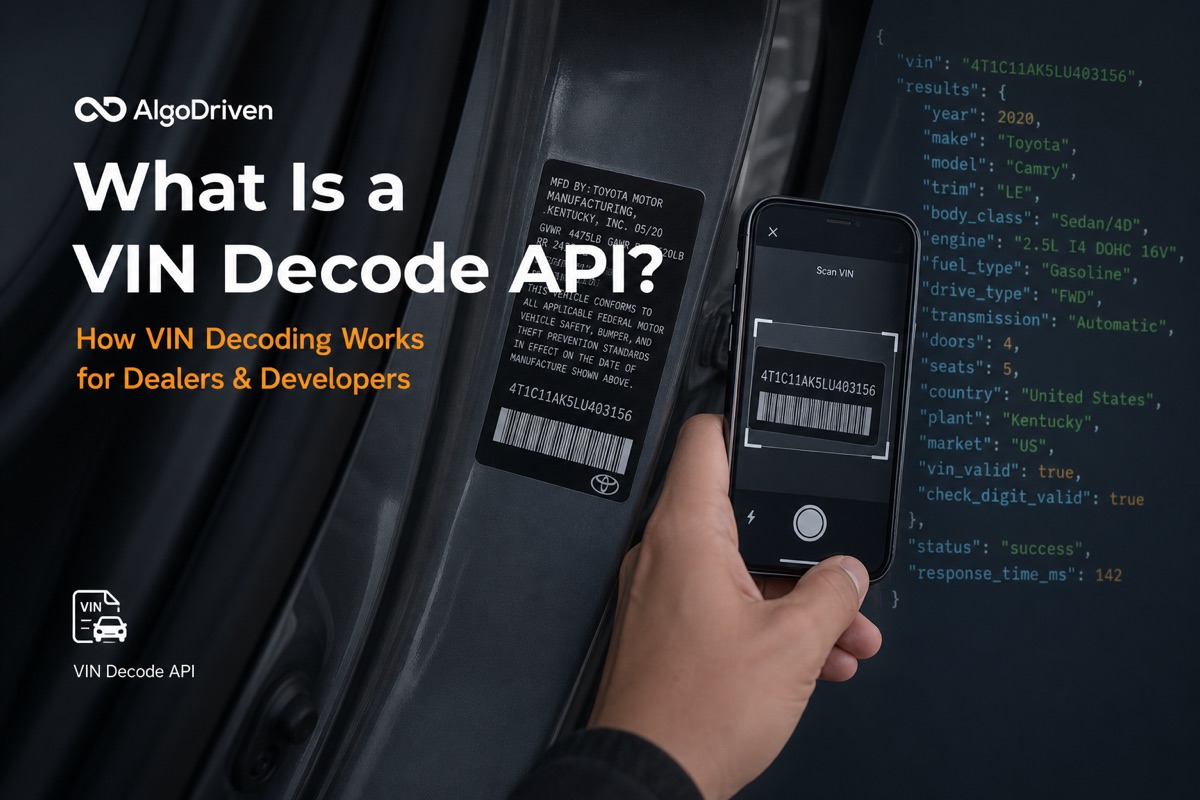
TLDR: A VIN decode API turns a car’s 17-character Vehicle Identification Number into structured data about that exact vehicle — make, model, variant, engine, colours and every factory-fitted option. For dealers it removes mis-described cars from the appraisal process; for developers it’s the identification layer that valuation, inventory and finance products are built on. The catch: most decoders are trained on North American data and get GCC and Australian vehicles wrong.
Start with the VIN itself
Every vehicle built since 1981 carries a 17-character VIN — a permanent fingerprint stamped into the chassis and printed on the build plate. It’s structured in three parts:
- Characters 1–3 (WMI): the World Manufacturer Identifier — who built the car and where.
- Characters 4–9 (VDS): the Vehicle Descriptor Section — model, body, engine and restraint details, encoded differently by each manufacturer.
- Characters 10–17 (VIS): the Vehicle Identifier Section — model year, plant and the serial number of that specific car.
The VIN alone tells you something. Matched against manufacturer build records, it tells you everything: the exact variant, the build month, the paint code, the interior trim, and every option fitted at the factory.
What a VIN decode API does
A VIN decode API is a web service that takes the VIN in and returns that build data as structured JSON. One request, and your system knows the car:
- Make, model, variant and series
- Model year and build date
- Engine, transmission and drivetrain
- Exterior and interior colours
- Factory-standard and factory-optional equipment — the actual options fitted to that specific car, not a generic spec sheet
The better decoders also accept a photo of the VIN plate: OCR extracts the 17 characters and the decode happens in the same call. In an appraisal lane, that means no transcription errors and no typing at all.
Why dealers should care
Because the most expensive mistake in used cars is valuing the wrong car.
A base variant priced as a high-spec one — or a “full option” claim taken at face value — puts the error into the deal before condition is even discussed. The gap between variants of the same model can be tens of thousands of dollars, and unseen factory options (sunroof delete? towing pack? premium audio?) swing values in both directions.
VIN decoding removes the guesswork at three points in the vehicle’s life at your dealership:
- At appraisal — the trade-in is identified precisely, so the valuation starts from the right baseline.
- At listing — the retail ad describes the car correctly, options included, which protects both the asking price and your reputation.
- At wholesale — buyers bid with confidence on an exactly described car, which shows up in the money.
Why developers should care
If you’re building anything in automotive — a valuation tool, a marketplace, an insurance quote flow, a fleet system, a finance origination product — vehicle identification is your foundation layer. Free-text make/model entry produces dirty data forever. A VIN decode at the point of entry produces one canonical vehicle identity that everything downstream can trust.
The practical integration looks like: user scans or enters a VIN → API returns the build → your product pre-fills the vehicle, keys pricing off the exact variant, and stores a stable vehicle code for later lookups. One field replaces a dozen dropdowns.
The regional data problem
Here’s what catches most teams: the VDS section of the VIN is manufacturer-encoded, and build databases are regional.
Most free and low-cost decoders are built on North American data. Point them at a GCC-spec Land Cruiser or an Australian-delivered Ranger and they’ll return the wrong variant, a US-market spec that doesn’t exist here, or nothing at all. Grey imports make it worse.
If your vehicles are in the Gulf or Australia, you need a decoder built on GCC and Australian build data. It’s the difference between “roughly this model” and “this exact car” — and, as above, that difference is measured in real money. This is precisely why we built our VIN Decode API around regional factory data, with GCC and Australian endpoints.
What to check alongside the decode
Knowing the car is step one. Knowing its past is step two:
- Vehicle history — title records, odometer readings, salvage/junk/insurance events, accidents and thefts across EU and US sources.
- PPSR (Australia) — an official certificate showing registered security interests, write-offs and stolen reports. Buying a car with money owing on it is an avoidable disaster.
Both are available as companion endpoints on the same API key, so one integration covers identification and risk.
Choosing a VIN decode API: the checklist
- Coverage for your region’s vehicles — ask for test VINs from your actual market and verify the variants come back right
- Factory options data, not just make/model/year
- Photo-to-VIN decoding for in-lane use
- History and PPSR checks on the same key
- A stable vehicle code that links to pricing and catalogue data
- Security posture — SOC 2 Type 2 and ISO 27001 if the data touches customer workflows
If you’re building something and want to test against real GCC or Australian VINs, request sandbox access — we’ll issue a key and test VINs so you can validate coverage before you commit.