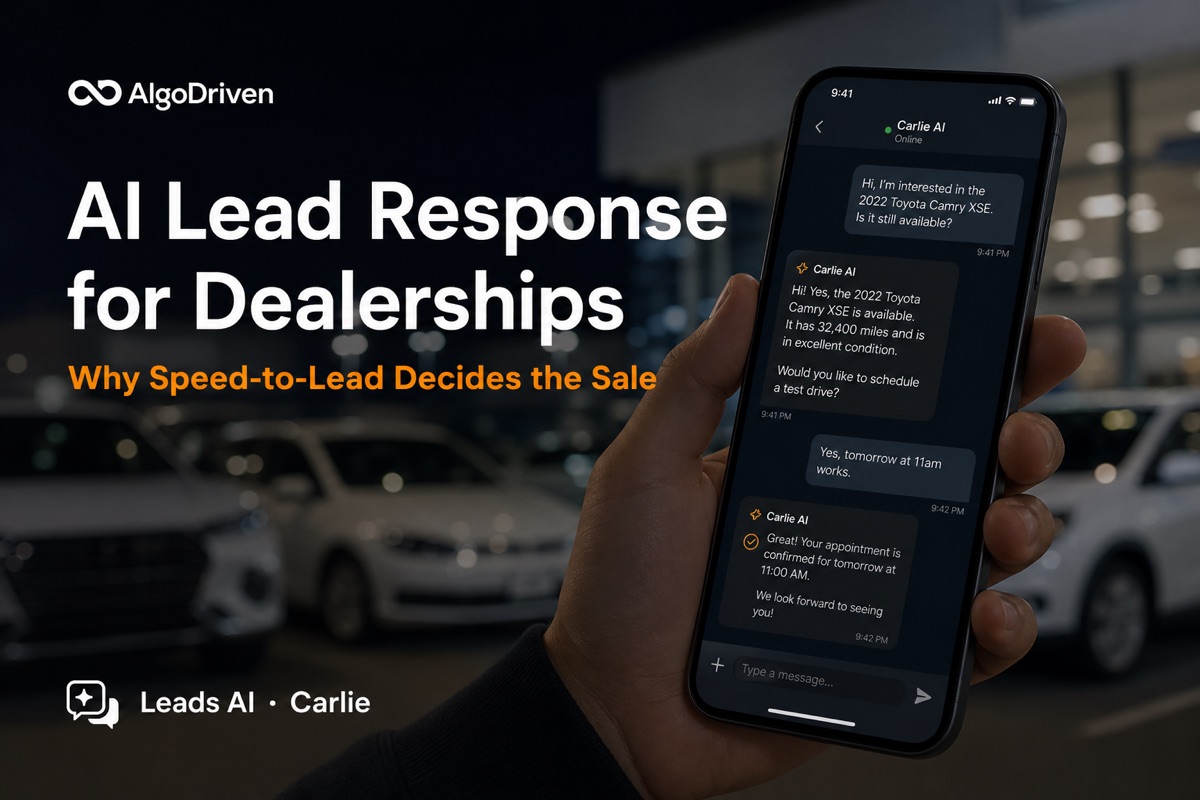
TLDR: Most used-car leads don’t die because the car was wrong or the price was high. They die because nobody answered fast enough. AI lead response fixes the two things a roster never can — speed and coverage — answering in seconds, 24/7, in the customer’s own language, with answers pulled from factory VIN data. The good ones book the appointment straight into your diary and know exactly when to hand off to a human.
Pull up your lead reports and look at one number: the time between a lead arriving and the first meaningful reply.
Not the auto-acknowledgement — “thanks, we’ll be in touch” convinces nobody. The first reply that actually answers the customer’s question.
For most dealerships that number is measured in hours, and overnight leads wait until mid-morning. Meanwhile the customer sent the same enquiry to three other dealers, and one of them answered in thirty seconds.
Why speed decides it
Used-car buyers don’t enquire on one car; they enquire on a shortlist. The dealer who answers first isn’t just polite — they’re the one who gets the conversation, and conversations become appointments.
This is a race a human roster can’t win. Nobody staffs the lead inbox at 11pm on a Sunday. Nobody replies in twenty seconds while they’re with a customer on the floor. And on a slammed Saturday, the leads that arrive while everyone’s busy quietly age out of relevance.
It’s the same lesson we keep seeing across dealership operations — from appraisals to lead handling: speed isn’t a nicety, it’s the mechanism. Momentum sells cars.
What AI lead response actually does
The category has a spectrum, so it’s worth being precise about what the good implementations do. Carlie, our Leads AI, handles the lead end to end:
- Answers instantly, always. Seconds, not hours — including the 11pm marketplace enquiry and the Sunday-morning WhatsApp. Across WhatsApp, SMS, email, marketplace messaging and your website.
- Answers about the actual car. “Does it have the tow pack?” gets a real answer, because the AI reads the factory build from the VIN — not the ad copy. That’s the difference between a chatbot and a lead expert.
- Speaks the customer’s language. English, Arabic, Hindi, Urdu, Tagalog and more, switching mid-conversation if the customer does. In multilingual markets — the GCC especially — this alone changes the numbers.
- Books the appointment. Checks opening hours, books the slot, sends the calendar invite and the showroom map. The lead arrives with your sales team as a booked, qualified appointment, not a phone number to chase.
- Plays by your playbook. Your dealership’s approach to trade-in, finance and discount conversations, applied consistently on every lead.
The part that makes it safe
Every dealer principal has the same worry: what if it says something stupid?
Fair. The answer is guardrails, and they should be non-negotiable in any tool you evaluate:
- Never commits a price, never agrees to sell a car. Full stop.
- Never wanders off topic or offers opinions. It’s there to sell metal, not discuss the news.
- Escalates immediately when a conversation turns complex or sensitive — a complaint, a legal question, a customer who just needs a human. Flagged and handed to your team, with the full conversation attached.
- Everything visible. Every lead and every conversation sits in a shared dashboard, so managers can see exactly what was said, to whom, and where each lead stands.
An AI on a short leash earns trust. An AI without one earns a story you don’t want to be in.
What it means for the team
The honest framing: AI lead response doesn’t replace salespeople — it replaces the worst part of their job.
Nobody’s best skill is typing “yes, it’s still available” for the ninth time before lunch. The AI absorbs the first-response grind: the instant answer, the spec question, the qualification, the booking. What lands with your team is the good part — a customer who’s been answered, engaged and booked, walking in at a set time. BDC hours get redeployed to the conversations that actually need a human.
And the leads that used to evaporate — the overnight ones, the busy-Saturday ones, the fourth enquiry while three staff are on test drives — get worked instead of lost.
How to evaluate it without the hype
Four questions for any vendor, ours included:
- “Where do the vehicle answers come from?” The right answer is factory VIN build data. The wrong answer is “the listing description”.
- “Show me the guardrails.” Ask specifically what happens when a customer pushes on price, and how escalation to a human works.
- “Which languages, and how well?” Have a native speaker test it before you trust it with your market.
- “Can we pilot one site and measure it?” Response time and appointments booked are the honest metrics. If a vendor resists a measured single-site pilot, that tells you something.
That last one is how we suggest starting anyway: one site, a few weeks, before-and-after numbers. If the appointments don’t move, don’t roll it out. Start a pilot and let the numbers make the argument.